WHO SHOULD YOU TRUST WITH YOUR FACE?
By: Jancey Marty
THE RISE AND RISKS OF MEDICAL AESTHETICS
TABLE OF CONTENTS


INDUSTRY GROWTH
At least 19 people have reported harmful reactions to counterfeit Botox, according to the CDC. As lawsuits mount against estheticians accused of practicing beyond their licenses, a gap is evident in an industry where many consumers lack clear guidance on who is actually qualified to perform medical aesthetic procedures.
The medical aesthetics industry is growing rapidly in the U.S.. Allergen Aesthetics research shows that eight out of ten people believe non-surgical aesthetic treatments are more acceptable now than five years ago. Charlotte Bader, a physician assistant at Batniji Facial Plastic Surgery in Newport Beach, shared how the pandemic contributed to the rise.
Allergen Aesthetics stated that social media also plays a large role. Manipulated images on online impact self-esteem. Social media has led to influencers sharing their treatment experience online, making aesthetics seem like a part of everyday self-care. But the reality is more complicated. What social media often leaves out is that these are still medical procedures – ones that carry real risk and should only be performed by qualified providers.
Complications from aesthetic treatments can include burns, infection, nerve damage, and in rare but serious cases, vascular occlusion – a blockage of blood vessels that can lead to tissue death or even blindness, according to the U.S. Food and Drug Administration.
Even treatments marketed as “non-invasive” are not risk free.
That tension – between how these procedures are presented and what they actually involve – raises a central question: In a rapidly growing, highly visible industry, how can patients determine who is truly qualified to perform procedures – and why are current systems failing to make that clear?
The demand for these treatments is growing rapidly.
According to Grand View Research, the global medical spa market was valued at $21.21 billion in 2024 and is projected to reach $78.23 billion by 2033, driven by rising demand for anti-aging and self-care treatments. In the U.S., the number of medical spas grew from 8,899 in 2022 to more than 10,00 in 2023 – reflecting how quickly new providers are entering the space
But as treatments become more normalized and accessible, experts say patients are increasingly navigating a crowded, fast-growing market without a clear understanding of who is properly trained to perform them and who isn’t.
WHAT IS
MEDICAL AESTHETICS?
Medical aesthetics refers to non-surgical procedures designed to improve the appearance of the skin, face, or body. The most treatments fall into three categories: injectables (Botox and dermal fillers), laser therapies, and microneedling.
While often grouped with beauty services, these treatments are legally classified as medical procedures in many states, including California.
Botox, for example, is a neurotoxin derived from Clostidium botulinum that temporarily signals nerve signals to muscles, reducing the appearance of wrinkles. Dermal fillers, by contrast, are injected substances used to restore volume and alter facial contours. Devices like lasers and microneedling tools go oven deeper – affecting layers of the skin that require clinical knowledge of anatomy and healing processes.
"A professional device is controlled – you can control the depth and the speed. At-home tools aren’t as accurate, and they can cause more damage than intended.”
Chanelle Chiana, Instructor at the International Dermal Institute
TYPES OF PATIENTS
Hannah Diffenderfer, a senior marketing manager for medical aesthetics at DermalogicaPro, says today’s medspa audience can be broadly divided into three groups — each with different motivations, expectations, and levels of knowledge.
“There are three different med spa clients: preventative, corrective, and post-treatment,”
Hannah Diffenderfer, Senior Med Spa Manager at DermalogicaPro
Preventative
Corrective
Post-Treatment
Preventative clients are often younger and driven by long-term skin health.
They are typically seeking non-invasive treatments and are heavily influenced by education and social media trends.
Corrective clients, by contrast, are focused on addressing specific concerns — such as hyperpigmentation, acne scarring, or visible signs of aging — and are often looking for faster, more noticeable results.
Post-treatment clients are those maintaining results from previous procedures, using professional skincare and follow-up treatments to extend outcomes and build long-term relationships with providers.
As these groups grow — particularly younger, preventative clients — providers say expectations are increasingly shaped before patients ever step into a clinic.
ONLINE
Today’s aesthetic patient is more informed – but not necessarily more accurate. Allergen Aesthetics describes a “hyper-informed aesthetic consumer,” shaped largely by social media, who arrives at appointments with highly specific treatment requests already in mind. Google search trends show rising interest in terms like “botox," “filler,” and “collagen,” while at-home medical grade skincare products and at-home devices have made aesthetic procedures feel more familiar and accessible.
Botox
Filler
Collagen

Data: Google Trends
With social media, there are hot topics that come up, and patients will come in asking if a certain procedure is right for them. It’s my job to educate them on whether it actually benefits them.
Charlotte Bader, Physician Assistant
This shift may also bring some challenges though. Patients have more information than ever, but they struggle to understand who and what to trust.
In the pursuit of educating the public, some providers have taken their knowledge to social media and have even become influencers themselves. They’re usually seen sharing skin care tips, explaining the science behind popular treatments, and answering frequently asked patient questions.
Charlotte Bader discusses botox browlifts on March 19, 2026 in Newport Beach, Calif. (@charbader.pa/Instagram)
Xochitl Renteln discusses azaleic acid in Losa Angeles, Calif. on March 31, 2026. (@xochitlrenteln/Instagram)
RULES PATIENTS DON'T SEE
On paper, medical aesthetics is clearly regulated. In practice, those rules can be difficult for patients to understand – and even hard to verify.
In California, treatments like Botox, dermal fillers, and lasers are legally classified as medical treatments. As stated by the Medical Board of California, they must be performed by licensed medical professionals such as Doctors of Medicine (MDs) or Doctors of Osteopathic Medicine (DOs) or by physician assistants (PAs), nurse practitioners (NPs) working under physician supervision. Registered nurses may also perform certain treatments with additional training and oversight.
Medical spas in California must have a qualified Medical Director that’s a licensed physician. According to the Business and Professions Code sections 2052, 2264, 2286, and 2400, to offer or provide laser and other cosmetic medical services, a business must be a physician-owned medical practice or professional medical corporation with a physician being the majority shareholder. California law also mandates that the Medical Director be involved in the daily operations of the business, including setting up treatment protocols, providing staff training, and handling any patient emergencies.
But for patients, these requirements are often invisisble. The physician does not need to be physically present, only “immediately reachable,” creating a gap between what oversight is supposed to look like and what patients may actually experience in the treatment room.
The structure can give the appearance of medical legitimacy, even with varying levels of supervision.
While tools like the Medical Board of California allow patients to verify whether a provider of Medical Director is licensed and in good standing, providers say most patients don’t know how to check. “The majority of people see a clinical setting and assume it has the proper credentials,” said Bader.
In an industry where treatments are marketed alongside beauty services and promoted heavily online, the responsibility often falls on patients to navigate complex systems of titles and licenses – without clear guidance on what those distinctions mean for their safety.
TRAINING
The training requirements for injectables like Botox and dermal fillers are designed to ensure patent safety. But for many patients, those standards create a sense of confidence that may not tell the full story.
In California, only licensed medical professionals are permitted to perform these treatments. They must receive training and certification from an accredited program. Curriculum includes injection techniques, safety protocols, management of complications, facial anatomy and hands on, live-model training. One of the programs, the American Academy of Facial Aesthetics, states, “the regulation aims to protect patients from potential harm and ensure that cosmetic treatments are performed by qualified professionals who understand the nuances of facial anatomy and the specific requirements of each product.” On paper, that training signals expertise.
Providers are also required to continue their education, to stay current as new techniques and products emerge. For example, physician assistants must gain 100 hours every two years of continuing medical education. Xochitl Reteln, a physician assistant at Facile Skin in Los Angeles, said she accumulates her hours through a mix of conferences, cadaver labs, and webinars to keep her skills up to date
"To get my hours and stay up to date on my skills and technique, I go to multiple conferences a year, cadaver labs, and also online webinars."
Xochitl Renteln, Physician Assistant at Facile Skin
If a provider fails to meet continuing education requirements they’re not supposed to perform these procedures. Enforcement mainly happens behind the scenes, through referrals to the licensing board after complications arise. Meanwhile patients are often left to assume that anyone offering these services has the same level of training and up-to-date knowledge. In reality, training quality and knowledge can vary widely – raising a central challenge for patients: not whether standards exist, but how to tell who is actually meeting them. Jennifer Adrales, a national injector trainer, emphasized the risk of improper technique.
"When someone doesn’t have the correct license, they aren’t medically trained to know the dangers, even slight errors like injection depth can cause serious complications."
Jennifer Adralles, National Injector Trainer
DANGERS OF DIY CULTURE
As medical aesthetics becomes more visible online, many patients are no longer choosing between providers but deciding whether to seek professional care at all. A growing market of at-home devices such as microneedling rollers and handheld lasers promise results comparable to in-office treatments at a fraction of the cost. Marketed heavily through social media ads and influencer partnerships, these products are presented as accessible alternatives, with little caution on the level of expertise required to use them safely.
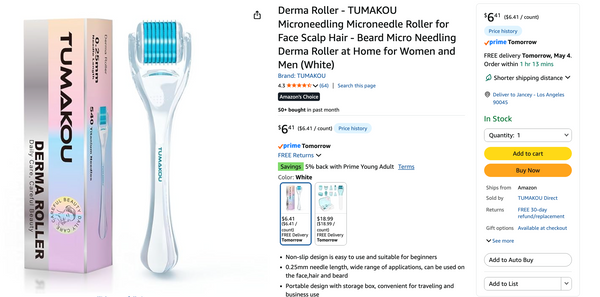
A dermal roller marketed for at-home microneedling is shown on Amazon.com on May 1, 2026.
But for buyers, the line between professional treatment and consumer product is not always clear. Esthetician Heewon Kim says many of her patients have inquired about these devices. “I understand why they’re interested,” Kim explained. “Microneedling treatments are extremely expensive and you have to get four or more sessions to see results.” Kim shared that she advises her patients not to buy the products online or try to do it themselves as it can lead to more harm.
"In a clinical setting, providers adjust treatment depth, speed, and technique based on the patient’s skin type, skin history, and specific concerns. At home, those safeguards don’t exist. Average buyers can’t tell if something is wrong or how to respond."
Chrystal Dietz, Instructor at the International Dermal Institue
The devices available online are not regulated to the same standard as medical-grade equipment – they aren’t reviewed by the U.S. Food and Drug Administration for safety or effectiveness. The FDA has cleared microneedling devices for the use on people aged 22 and older as a treatment to improve the appearance of acne scars, wrinkles, and surgical scars. Approved devices have the necessary data to support the reasonable assurance of the safety and effectiveness of the device. At-home tools are not held to the same level of review, despite being marketed with similar claims.
The same confusion extends to injectables. While FDA-approved products like botulinum toxins and hyaluronic acid fillers are regulated medical treatments, similar products are increasingly sold online through unverified channels. Many are even sold under false names. In some cases, products marketed as hyaluronic acid fillers or neuromodulators may be counterfeit and contain unknown substances – increasing the risk of severe complications. “Those can lead to serious consequences and I’ve heard of hospitalizations happening,” Bader shared. “You can have vascular occlusions with dermal fillers that can even lead to blindness or skin death and so these procedures can be very dangerous if done at-home and not by a licensed trained provider.”
For patients, the appeal is clear: lower cost and convenience. But experts say those benefits can mask a more critical question – whether the patient or provider themselves has the knowledge to do it safely.
WHEN THINGS GO WRONG
Despite clear laws, unsafe practices continue to surface. A review of news reports from 2025 to 2026 shows multiple cases of unlicensed individuals performing cosmetic procedures. In a year, there have been at least 60 separate cases leading to complications, arrests, and even deaths. Most cases involved facial and buttock injections.
Despite common misconception, estheticians and medical assistants can’t administer injectables, chemical peels, or lasers. “Estheticians treat the epidermis,” shared Andrea James and esthetician. “Under California law, we (estheticians) can only provide treatments that don’t penetrate the skin.”

NELSON V. DAKAR
In 2021, Victoria Nelson sued Beverly Hills esthetician Sonya Dakar who gave her a chemical peel which left severe burns and permanent scarring. Nelson is currently seeking about $71,000 from Dakar for allegedly making “false representations” to her about “her professional qualifications and licensure and the nature and legality of the treatments provided.” The suit claims that Dakar “performed procedures on her, such as microneedling and procedures using a lancet, which are outside of the lawful scope of an esthetician’s license in California.”
The California Board of Barbering and Cosmetology states that estheticians are not allowed to perform microneedling or laser treatments. According to the database, the board revoked her license in 2022 following accusations that the clinic had advanced tools for the “practice of medicine,” such as laser machines, and refused inspector access.

Victoria Nelson shows chemical burns in Los Angeles, Calif. on May 4, 2021. (Photo/Victoria Nelson)
“Five years later and I still can’t look in the mirror without being pulled back into her treatment room, my heart pounding, feeling my skin burn all over again. I felt deceived, I didn’t think to ask her about her license, I shouldn’t have to.”
Victoria Nelson, Plaintiff
“Providers must only practice within their scope. Of course, patients are going to trust their providers – they don’t know what any of it looks like. But it’s also critical to know what their licensing is and what it allows.
Jennifer Adralles, National Injector Trainer
According to the Medical Board of California, unlicensed individuals are prohibited from performing procedures that penetrate the skin – yet cases like this suggest those boundaries are not always enforced.
ETHICS
Unlike traditional healthcare, medical aesthetics is largely a cash-based industry – meaning providers are paid directly for elective procedures. This structure can create tension between patient care and business incentives. This can lead to providers “over prescribing” in a sense. Patients may come into the office asking for anything and everything, and some providers aren’t inclined to say no to the money. This can lead to over-filled and unbalanced results.
Industry discussions increasingly focus on concerns around overtreatment, particularly as patients arrive with highly specific demands influenced by social media.
RED AND GREEN FLAGS
In an industry shaped by rapid growth, inconsistent supervision, and heavy social media marketing, determining who to trust becomes critical. Experts say patients should look out for several red and green flags when choosing a provider..








Bader reflected on a time she had to tell a patient ‘no,’ “Patients will get their lips done once and continue filling them up. It’s up to the provider to tell the patient, ‘hey, if you do another syringe it’s going to look unnatural, it's not going to be balanced with the proportions of your face and we might need to wait 6 months to a year until we treat it again.”

Patients themselves often prioritize these factors. Tessie Perez, who has been receiving Botox and filler for several years, said she chose her provider based on experience and results. “I didn’t want to have a frozen face with pillow lips,” she expressed. “I made sure to look at a variety of options and their results.”
Diane Sullivan, discussed that she chose Bader as her provider based on her educational series on social media. “She answers all my questions,” Sullivan added. “Most of the time I send her things I see on Instagram or TikTok and she’ll explain if they’re a good option for me or not.”
Before and after Tessie received 1ml of lip filler in Newport Beach, Calif. on March 23, 2026. (Jancey Marty/Photo)
As medical aesthetics continues to grow, the question isn’t about access anymore, it's about accountability.From counterfeit Botox to cases of lawsuits against providers practicing outside their scope, the risks facing patients are not hypothetical. At the same time, social media and at-home treatments have made it harder than ever to distinguish between medical expertise and marketing.
On paper, regulations and training requirements are in place. Oversight structures are established. But for patients, those safeguards are often invisible – leaving them to navigate a complex system of credentials and online influence without clear guidance on what actually keeps them safe.
Providers have grown their own online presence in an attempt to educate online. But education alone cannot replace transparency or enforcement. If patients continue to trust anyone in scrubs, the consequences aren’t just aesthetic – they’re medical.
Until the industry closes the gap between regulation and reality, patients are left to decipher who is truly qualified to perform these procedures.